European Accessibility Act · in force since 28 June 2025
A French court just ruled that 71% accessible is not accessible.
Accessibility is an obligation of result, not effort — a site can’t be “a bit” accessible. We scanned 290 live Shopify stores across six EU markets. 287 fail; the median has 32 broken elements, nowhere near 71%.
We will tell you your store’s number. Free, within one business day.
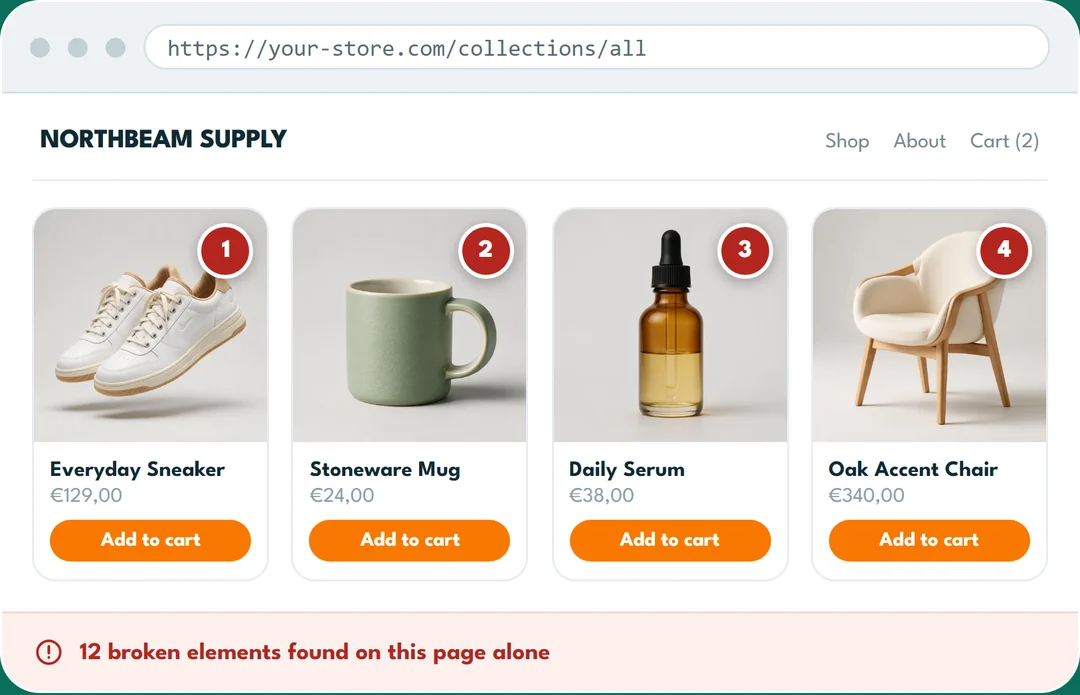
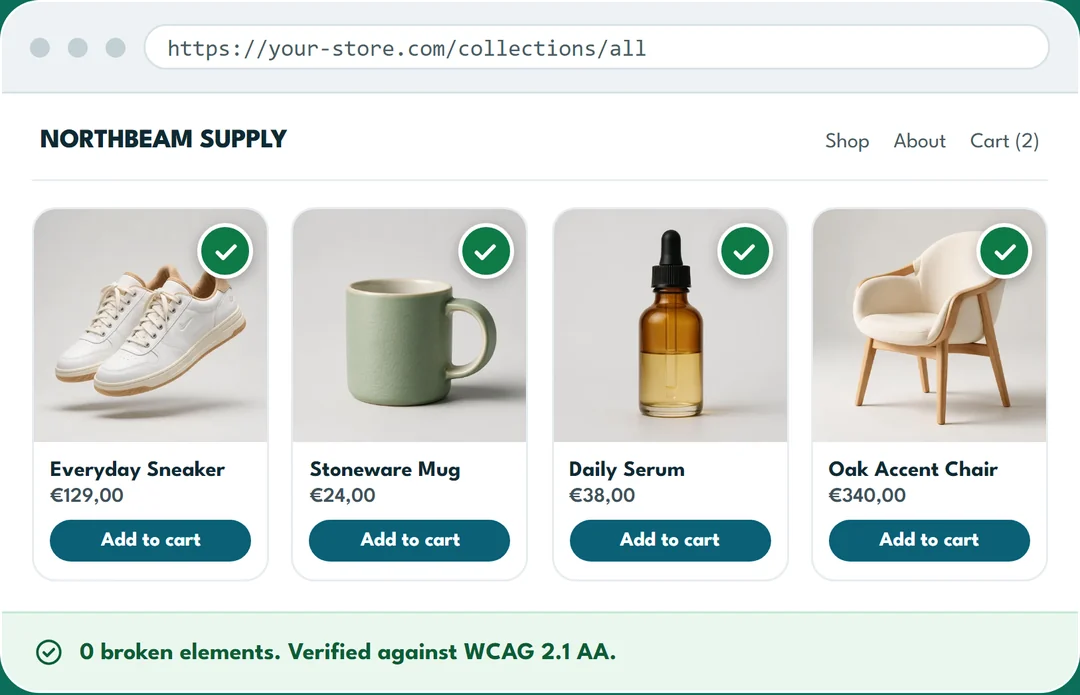
An illustration, not a real merchant — but every failure in it is one we measured:
- Add to cart, unreadable. White on orange is 2.73:1. The floor is 4.5:1. 82.1% of stores.
- Image with no text alternative. A screen reader announces nothing. 42.4%.
- Link with no accessible name. Announced only as “link”. 56.6%.
Our own measurement · 290 stores · six markets · 2–3 August 2026
13months the law has been in force, and counting
99%of the stores we scanned fail, on a critical or serious issue
32broken elements on the median store
728on the worst store we found
Why it would be you
Nobody audits you. Somebody reports you.
Enforcement here is complaint-driven — it begins with one customer who couldn’t check out, not an inspector working down a list of eight million stores.
-
Ongoing
Sweden’s regulator works through 124 complaints; the Dutch ACM sends requests to e-commerce operators worldwide, including outside the EU.
-
4 Jun 2026
Tribunal judiciaire de Caen orders Carrefour to fix its site within six months — €500/day penalty plus €10,000 damages. Carrefour argued 71% was enough; the court disagreed. Source →
It applies by where your customer is
Sell to a consumer in the EU and you’re in scope. The microenterprise exemption covers services, not products. Penalties reach €900,000 in Sweden, €600,000 in Spain, or 0.1% of turnover/day in France.
87–100 million people in the EU live with a disability. Every broken element is someone who reached your product page and never reached payment — you’re already paying for this. The invoice just has no name on it.
What this is
We find them, fix them in your code, and prove it
Not a widget. Not an overlay. Not a PDF of recommendations.
Evidence
An automated scan of your real templates — exact element, exact code, criterion failed.
A human on the buying path
Someone drives your store with a screen reader — arrive, pick a variant, add to cart, reach payment.
Remediation in the source
We fix the violations in your theme code and hand back a pull request or corrected theme, plus a before/after report.
A lawsuit is never filed because of a list. It is filed because a person could not buy.
We work on a copy; you review it before anything goes live. If a fix breaks something, we revert it and fix it at our cost.
Pricing
Published prices. No sales call.
In US dollars, billed through Paddle as merchant of record for EU VAT.
Start here
Free Scan
$0
Automated. In one business day.
- Home page + one product page
- Violations by severity
- The five worst, with exact code
Exposure Report
$250
In 72 hours.
- Ten templates, including checkout
- Manual screen-reader test of the buying path
- Findings ranked by risk, effort per fix
- Draft Accessibility Statement
- Credited in full against the Fix, within 30 days
Most of the work
Fix
$2,500
In 10 working days, verified before month end.
- Shopify, WooCommerce or BigCommerce theme, up to 10 templates
- Every critical/serious violation fixed in real code
- Re-scan plus a second screen-reader pass
- Pull request or corrected theme, deployed
- Before/after report + Accessibility Statement
- Kept clean after for $70/month. Optional.
We run three to four fixes at a time — hand-written code, verified by the same person every time. Slots fill up; we tell you the real start date before you pay.
Out of scope, quoted from $6,000: headless storefronts, fully custom themes, more than 10 templates, PDFs and video without captions. And two platforms we will not sell you a fix for at all: Wix and Squarespace. They generate their own markup and do not let anyone edit the DOM, so a real share of the violations belongs to the platform, not to you. We will still scan your store and tell you exactly what is broken — including what you can change inside the editor, and what only moves if you move platform.
What you are paying for
The 60% a scanner will never find
Automated scanning catches roughly 30–40% of accessibility problems — the central fact of this field. It can’t tell you whether a blind customer reaches checkout. The rest needs a person testing with a screen reader — why this costs more than a free scanner.
We will never tell you that you are “compliant”
No vendor can certify compliance — one that says otherwise is selling you a liability. We report violations found and remediated, verified against WCAG 2.1 AA, with evidence and a date. We do not sell, install or recommend overlays — not one of the 290 stores we scanned had one. Why that matters, with the FTC numbers →
This is not legal advice. We remediate technical violations against a published standard; your Accessibility Statement should be reviewed by counsel in your market.
The study
Nobody had published this, so we measured it
290 confirmed Shopify stores, six markets, home page and one product page — each tested twice, desktop and mobile, because a desktop-only audit reports a store cleaner than it is.
The failures that repeat — share of the 290 stores
Your theme isn’t the problem: Dawn appeared in only 3.1% of stores. We measure your store, with your apps and content — and show you every element.
Read the full study — method, per-market data and limitations
Who we are
Verify us. Do not trust us.
No client logos, testimonials or founding year — inventing those is exactly what got the overlay industry fined. Here is what you can check instead.
A product of Sell with Marketing, a B2B marketing and engineering agency.
Led by Manuel García — twenty years in B2B go-to-market, ex-Colgate-Palmolive, Circle K, Quala. One person does the testing and the fixes.
Zero violations here — 100/100/100/100 on Lighthouse.
The study is reproducible — open tools, public stores, dated.
No access, no deadline, published prices.
Payment through Paddle — never a bank transfer to a person.
Refunds & legal notice
Exposure Report: no violation found, no charge. Fix: full refund before work starts, pro rata after. Watch: cancel any time.
Service provider: Sell with Marketing, Mexico — hello@sellwithmarketing.com. Payments processed by Paddle.com Market Ltd. as merchant of record; governing law is stated in your engagement letter.
Free scan
Get your store’s actual number
The same scan we ran on 290 stores — your home page and one product page. Violations by severity, the five worst with the exact code, within one business day.
Questions
The ones that actually get asked
You emailed me out of nowhere. How do I know this is not a scam?
Fake accessibility demand letters share three features: a ~15-day deadline, a request for admin access, and no price until you reply. We do none of those.
Does this only work for Shopify? What about WooCommerce, Wix or Webflow?
The scan works on any platform. The law does not care what your store is built with, and neither does our scanner — we detect the platform and find a real product page automatically.
The fix is where the platform matters. Shopify, WooCommerce and BigCommerce give us full access to the theme code, so the $2,500 price applies. Webflow is fixable but through the Designer rather than templates, so it is quoted separately. Wix and Squarespace we will not sell you a fix for — they generate their own markup and do not let anyone edit the DOM, so a real share of the violations belongs to the platform and cannot be corrected from outside. We will still scan you and tell you what is broken, what you can change inside the editor, and what only moves if you move platform.
Can my own developer or agency not do this?
Some of it — but 82.1% of what we measured is contrast and missing names, invisible to a sighted developer. Buy the $250 report and hand your team the list.
What if you break something on my store?
We work on a copy — a theme export or a branch — and you review it before anything goes live. If a fix breaks something, we revert it and correct it at our cost.